Plaster and lath
Loose, bulging or cracked plaster in older houses, reattached or patched level with the surrounding wall.
Cracked plaster, holes, water-stained ceilings and basement walls that soaked up water, repaired and textured to match so the fix blends into the wall around it.
Some jobs are simple enough to handle on your own. If yours is one, we'll tell you.
Call 7 days, 7am–9pm
Once you've rung, the Atchison-area pro who'd do the drywall work calls back, hears what broke and quotes it ahead of any booking.
What comes next: an Atchison-area drywall pro gets in touch, goes over the problem with you and prices it before any date is fixed.
Take the pictures first. After soaked board gets removed and hauled off, the evidence goes with it.
Coverage is a matter for your policy, or your lease, to settle. A clear record makes that conversation shorter. Your phone and a spare moment cover it. Here is what is worth capturing before anyone touches the wall:
Keep everything in one album. Renters should send the photos to the landlord before a repair is booked, so the record belongs to both of you. What any policy pays is outside what we can answer, so no guesses here.
Most wall trouble in Atchison falls into one of these four. Each of the pages below lays out why it happens, what a sound repair takes, and where the scope grows.
Loose, bulging or cracked plaster in older houses, reattached or patched level with the surrounding wall.
Thin cracks, corner cracks off doors and windows, and split seams, opened up, taped and refinished rather than smeared over.
Lower walls that wicked up water, cut off straight over the soaked part and rebuilt with suitable board.
Stained or soft ceilings near the outside wall after a winter thaw backs water under the shingles.
Doorknob holes, nail pops and dented corners are plain drywall patching. They don't need a page of their own. Put them on the form and they get priced with everything else.
Basement drywall isn't like upstairs drywall. It sits against concrete that stays cool and can pass moisture through.
Wait for dry. If the wall got wet, the board, the studs behind it and the room itself all have to dry out before any replacement sheet is hung. Closing in damp framing traps the problem behind a fresh wall. That call is made with a meter on the studs, never by feel.
Leave a gap at the floor. Board that sits right on the slab wicks water up like a paper towel. A proper repair stops the new sheet about half an inch above the concrete and lets the baseboard hide the gap.
Garage walls follow their own rule. Where a garage shares a wall or ceiling with living space, that surface is built as a fire separation, often using Type X board, which is thicker and more fire-resistant than standard sheets. A patch there should be the same fire-resistant board with taped seams, not a scrap of half-inch left over from another room.
Dents are small. A car door or a bike handlebar into a garage wall makes a short job. If the garage isn't painted, it doesn't need a paint-grade finish either, and that keeps the price down.
On a sloped lot, one basement wall is often buried deeper than the others. That is usually the wall that shows water first after a hard rain or a spring thaw. The page on drywall repair after basement water covers the cut line and the rebuild.
Size is the first thing that sets the price. It isn't the only thing. Here is the plain list.
For rough numbers, national cost guides are a fair starting point. They are not a quote, and they are not Atchison prices. Inch Calculator's cost guide for drywall work lists a small repair at roughly $60 to $200 nationally, and puts bigger jobs, or a handful of small fixes done at once, at about $300 to $900. Thumbtack's guide to drywall ceiling repair puts the average at around $354 to $1,064. The price a local pro gives you for your wall may land inside, below or above those figures. That quote is the number that counts.
A single nail pop or a pencil-size hole isn't worth hiring out.
A tub of spackle and a putty knife are enough for that. Anything bigger than your hand, anything overhead and anything that got wet is worth a pro.
The age of the house decides most of what a repair involves. Atchison's housing is old.
Census Bureau estimates from the American Community Survey (2020 to 2024) tally 4,175 homes of every kind in the city. Of those, 1,416 date to 1939 or before, about a third of the total. The next biggest group is the 1970s, with 1,030 homes. A mere 131 went up in 2000 or later.
What that means on the wall: a house from before 1940 is usually plaster over wood lath unless someone has replaced it. Plaster is hard and heavy, and it grips through small lumps that squeezed behind the wood lath. When the keys break, it sags or bulges. A house from the 1970s is drywall, often with sprayed ceilings. The two need different repairs, and the pro pricing yours should know which one is on your wall.
Most homes here, 3,272 of the 4,175, are detached houses. Renters live in about four in ten occupied homes (1,377 of 3,482), so move-out patching matters to plenty of landlords and tenants in town.
The town itself goes back to 1854, on the Kansas side of the Missouri River. The house where Amelia Earhart was born in 1897 was built in 1861 in the Gothic Revival style, and it stands on a bluff overlooking the river.
We pick up, study what you send, and ask what matters: size, location and if any part is still damp.
An area drywall pro calls you, goes over the damage and quotes a number. Nothing gets scheduled until you've heard it and said yes.
We set a day that fits your week. Drying time between coats is part of the plan, so you know up front if it spans two days.
Anything loose is trimmed away until only solid board or plaster is left. The patch is fastened, taped, coated in thin layers, sanded and textured to match.
Expect primer on the repair so it can take your paint, or a finished paint coat if that was in the quote.
There is a short write-up of how this business handles a repair request on the about page.
| Patch | Skim coat | New board | |
|---|---|---|---|
| Best for | A hole or damaged spot with solid wall around it | A wall with many small cracks, old patches or rough plaster | Wet, crumbling or badly broken sections |
| Typical size | From coin size up to a square foot or two | A whole wall or a whole ceiling | A full sheet or more, or everything below a cut line |
| Dust | Light, kept to one spot | Moderate, since the whole surface is sanded | The most, because old material comes out |
| Drying between coats | A few thin coats, often over two days | Two or three coats over the full surface | Tape, fill and finish coats, usually several days |
| Texture match | Blended at the edges into the old texture | New texture over everything, so no edge to hide | Textured to match the wall around it |
| Wrong choice when | The wall around it is loose or still wet | The plaster no longer grips its lath | The damage is small and the wall around it is sound |
Still unsure which one your wall needs? Read the guide to patching versus replacing.
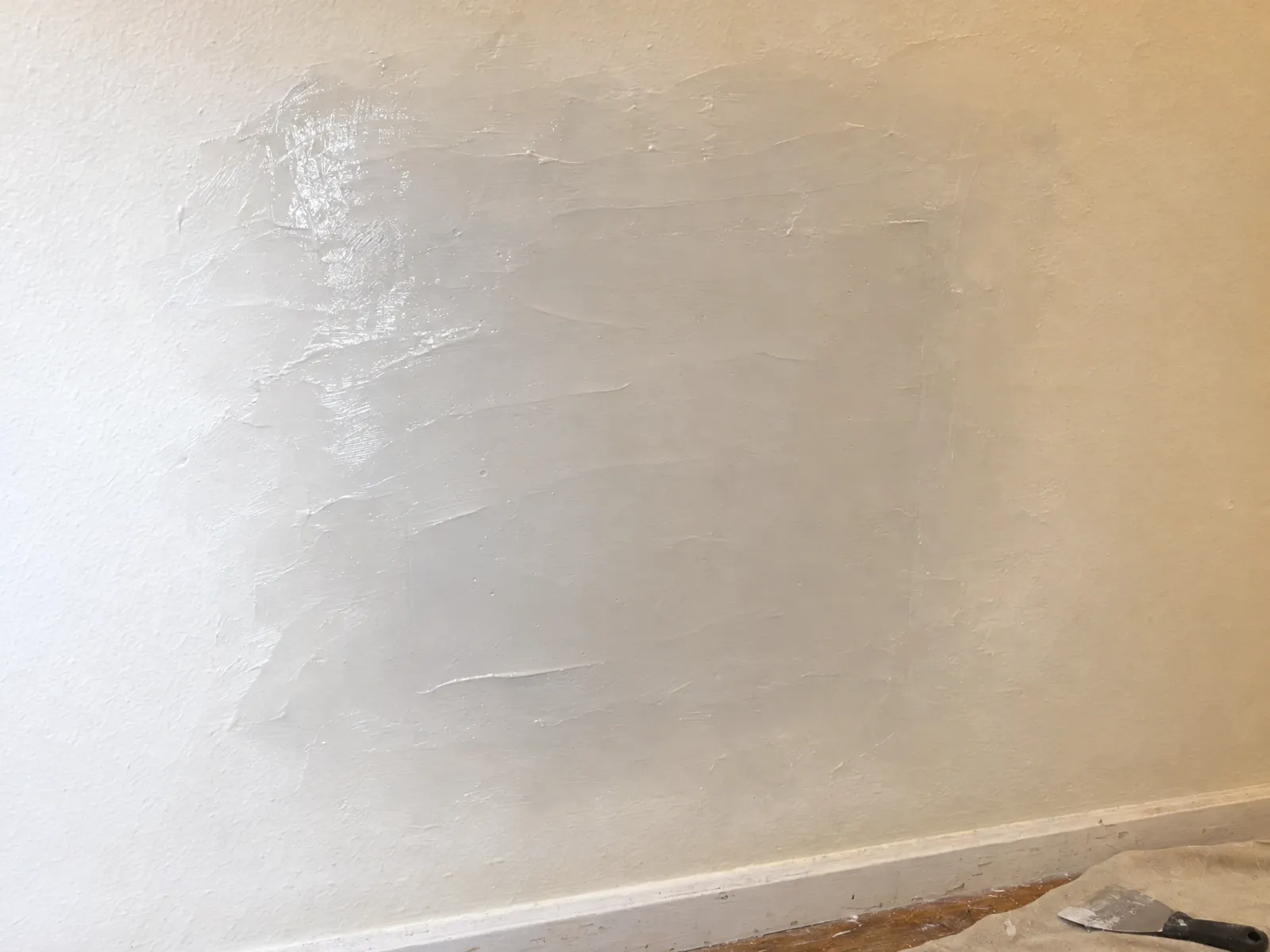
A patch can be flat and smooth and still show. The reason is usually the paint, not the compound.
Bare mud drinks in paint unevenly compared with a wall that's already painted. Paint over bare compound dries duller, and the repair turns into a flat-looking square under low side light. That's called flashing. Primer is the answer: it seals the compound so the finish coat dries the same over the patch and the wall.
Sheen matters too. Eggshell and satin show touch-ups far more than flat paint does. A touch-up dabbed onto a satin wall often reads as a patch even when the color is right. Painting the wall from corner to corner is the dependable way to make it disappear into the rest.
Texture comes before primer. If the wall has orange peel or knockdown, the patch gets textured to match, then primed, then painted.
Who paints is up to you. Some people want the wall primed and left for their own paint. Others want it finished. Say which on the call, and it becomes part of the price.
Water stains need one extra step: a stain-blocking primer. Ordinary latex primer lets the tan outline seep back through. Stain-blocking primer is formulated to lock that ring in.
Ceilings get their own rules, because gravity works against every repair overhead.
Winter leaks near the eaves have their own page: ice dam damage overhead.
Atchison is home base. Repairs also get booked across the rest of Atchison County, just across the river in Missouri, and down in Valley Falls.
Ring the number, or message a picture of it. If it's small enough to handle yourself, you'll hear that. If it isn't, you'll know the figure from the pro doing it while nothing is on the schedule yet.
Once you've rung, the Atchison-area pro who'd do the drywall work calls back, hears what broke and quotes it ahead of any booking.